
2DOC vs. 4DOC: Stop Chasing Invoice Disputes and Get Paid on Time
Sep 03, 2026

You shipped the goods and sent the invoice, but now payment is on hold because the buyer claims that what arrived doesn’t match what you invoiced.
So you issue a credit note, wait for confirmation, and reissue the invoice. Meanwhile, your cash flow stalls, and your accounting team spends time addressing a problem that began the moment the invoice was sent, before anyone confirmed what was actually received.
This is not an edge case. For suppliers delivering to retail, invoice disputes are a routine cost of doing business under 2DOC. The question is: does it have to be this way?
In retail supply chains, minor discrepancies such as missing products, damaged cartons, or mismatches between delivered and invoiced quantities can delay goods acceptance, hinder payments, and create extra work for both buyers and suppliers.
What is the 2DOC supply process?
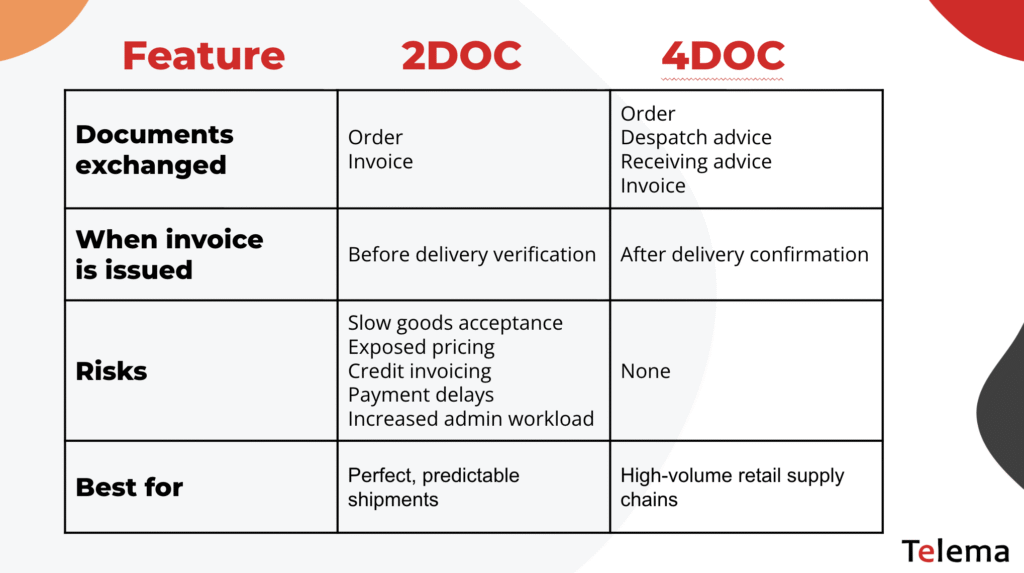
2DOC is named after the two electronic documents exchanged between buyer and supplier: the order and the invoice. The buyer sends an order, while the supplier delivers the goods and issues an invoice. That’s it, and it’s exactly the problem described above. With just these two documents in the workflow, the supplier does not know what has actually been received before the invoice is issued. These discrepancies are more common than one might assume.
Complications with 2DOC
“2DOC works well when everything goes exactly according to plan, but things rarely do,” explains Sven Uustalu, Telema’s EDI Business Line Manager. “The main weakness is timing, as the invoice is issued before the buyer ever confirms what actually arrived.”
Any deviation between the order, shipment, and delivery creates a mismatch that must be resolved manually later on. This can lead to several recurring problems:
- Slow goods acceptance: warehouse and accounting teams must investigate discrepancies before goods can move forward
- Exposed pricing: invoice data passes through logistics teams who don’t need to see commercial pricing
- Credit invoicing: suppliers end up issuing credit notes or corrected invoices after delivery
- Payment delays: buyers hold payment until invoice disputes are resolved.
- Increased administrative workload: both sides spend time exchanging additional documents and correcting records
What is the 4DOC supply process?
The 4DOC model prevents invoice disputes by inserting two quick verification steps between the purchase order and the final bill: a despatch advice and a receiving advice.
As a result, the process relies on four documents instead of two. These are:
- Order – same as before, sent by the buyer.
- Despatch advice (desadv) – sent by the supplier when the goods leave the warehouse. It confirms what was actually shipped, typically including quantities, packaging details, and delivery information. Importantly, it does not need to include pricing, so logistics teams can process it without seeing commercially sensitive figures.
- Receiving advice (recadv) – sent by the buyer after they’ve received and checked the delivery, confirming the number of items received.
- Invoice – (ideally) automatically generated and sent by the supplier based on the receiving advice, reflecting exactly what the buyer confirmed they received.
By confirming the delivered items before the bill goes out, both sides work from agreed numbers, eliminating payment holds and the need for credit notes.
Prefer a visual breakdown? Watch our quick 2-minute video explainer on 2DOC vs 4DOC to see how the document flow works in real-time.
4DOC Scenario
Consider how this plays out during a standard delivery:
A retailer orders 8 cartons of milk, but you only have 7 in stock. You ship the 7 available cartons and send a despatch advice for 7—omitting pricing details.
During transport, 2 cartons are damaged. The buyer inspects the delivery, accepts the 5 intact cartons, and sends a receiving advice confirming 5. You then issue an invoice for exactly 5.
Because your final bill matches what was physically accepted at the dock, you avoid issuing credit notes for damaged goods, bypass payment holds, and get paid on time.
Benefits of 4DOC
The strength of 4DOC comes down to timing, resolving discrepancies before the invoice is ever generated. This proactive approach delivers four key benefits for suppliers:
- Products reach shelves faster: warehouse staff can process deliveries against the despatch advice without waiting for accounting to reconcile numbers.
- Prices remain confidential: logistics teams can process despatch information without seeing invoice prices.
- Fewer credit notes: the invoice is based on what the buyer actually received.
- Invoices are paid on time: those that match confirmed receipts aren’t held up in dispute resolution.
Major retailers like Rimi and Prisma have already adopted 4DOC.
Merje Aavasalu, the CFO of Prisma, told Telema that they “see this system as a win-win for everyone,” explaining that “It’s not just about making our operations more efficient. It’s also about making things easier for our suppliers, which in turn helps us deliver better service to our joint end customers.”
For suppliers in the fast-moving consumer goods (FMCG) sector, this efficiency can be game-changing.
Ready to eliminate payment holds?
Book a 15-Minute 4DOC Demo →