
SSCC: Faster receiving, better traceability
Mar 13, 2026
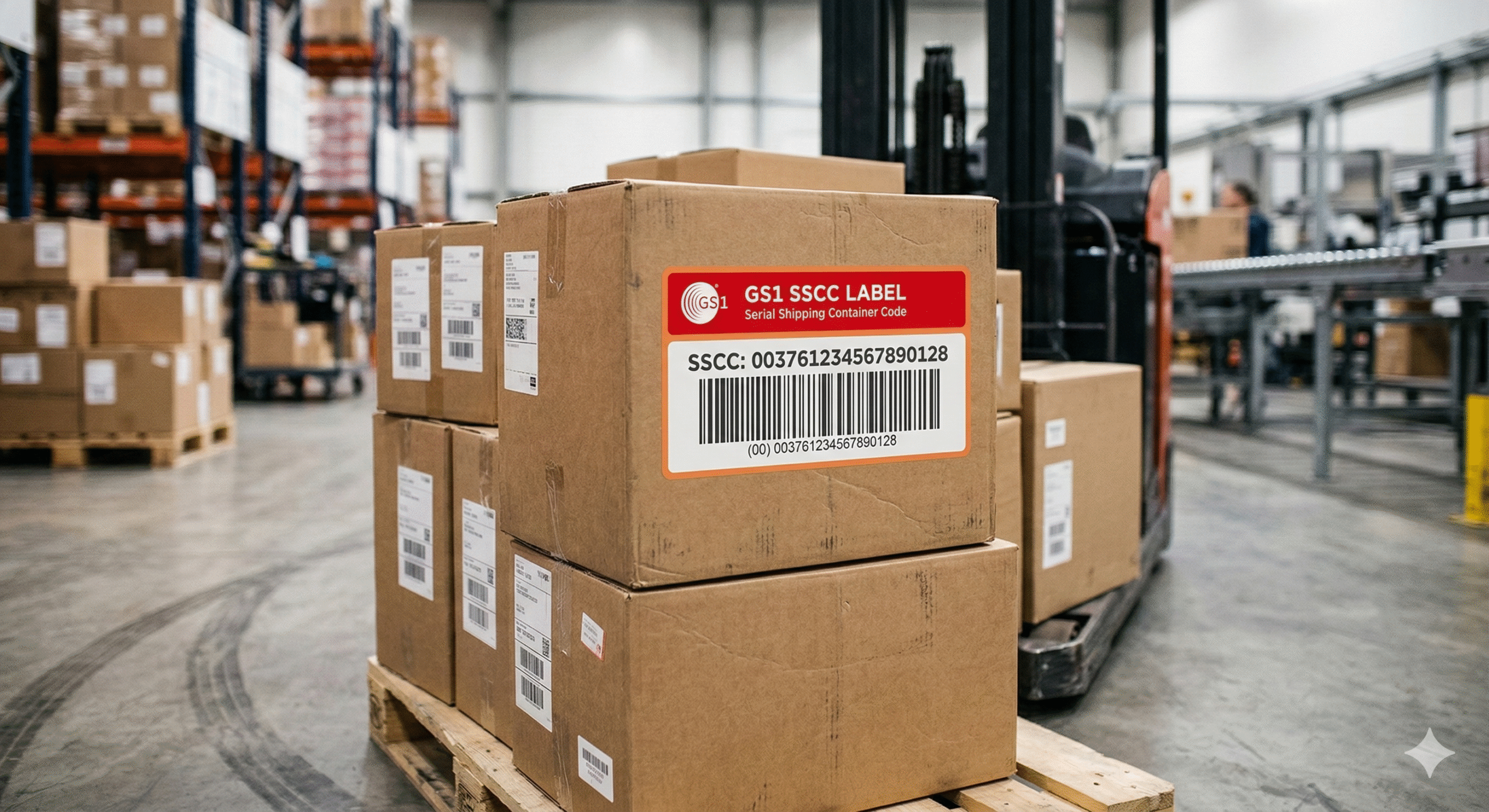
In today’s FMCG supply chain, thousands of pallets and containers move every day. As retailers increasingly expect suppliers to identify logistics units clearly and consistently, SSCC is becoming an important part of this process. At first glance, it may seem like just another requirement, but in practice it helps make shipments easier to identify, easier to trace, and easier to receive correctly at their destination.
What is SSCC?
SSCC (Serial Shipping Container Code) is an 18-digit code defined by GS1 standards and used worldwide to uniquely identify pallets. In this article, we mainly talk about pallets, but in practice SSCC codes can also be used for other logistics units, such as cartons or containers.
SSCC is printed as a barcode on a logistics label attached to the pallet.
SSCC does not describe the contents of the pallet. It serves as a unique identifier — similar to a passport number or license plate for a specific pallet. Unlike product barcodes such as GTIN, SSCC identifies not the product itself, but the pallet on which the products are placed.
How does SSCC work in practice?
When preparing a shipment, the supplier creates a unique SSCC code for each pallet. This code is added to the EDI despatch advice (DESADV), which also describes the contents of the pallet — which products, batches, and quantities are on it.
When the goods arrive at the warehouse, scanning the SSCC code is enough for the retailer’s warehouse system to immediately find the corresponding pallet information from the DESADV message. Instead of checking each carton individually, the system already knows what should be on that pallet.
In practice, one pallet may contain several batches, depending on the agreements between the supplier and the retailer. Batch numbers, serial numbers, or best-before dates are linked to the SSCC code in the electronic message.
SSCC is especially useful when a shipment contains many pallets. Without it, warehouse staff may need to search which pallet contains which products, whereas with SSCC, a single scan immediately identifies the pallet and its contents.
For suppliers, SSCC also improves shipment handling before the goods even leave the warehouse. When each pallet has a unique identifier, it is easier to label, identify, and link it with the related shipment data. This reduces confusion during dispatch and makes follow-up easier if questions arise later.
Automated verification in the warehouse
In many retailer’s warehouses, the receiving process is at least partly automated.
After the SSCC code is scanned, the pallet may be weighed. Since the expected weight of the pallet is known from the despatch advice, the system can verify whether the correct number of cartons is present.
If the weight matches the expected value, the system confirms the pallet automatically. If the weight does not match, the system flags a discrepancy and a warehouse employee checks the shipment manually.
The combination of barcode scanning and automated verification significantly reduces manual work during receiving.
Why is SSCC important for suppliers?
Smoother receiving
When shipments are clearly identified and linked to DESADV data, retailers can receive them faster and with fewer manual checks. This helps suppliers avoid delays and unnecessary clarifications.
Improved accuracy
A clearly identified pallet reduces the risk of misunderstandings between what was shipped and what was actually received.
Better traceability
Each pallet has a globally unique identifier, making it easier to trace where specific batches have moved within the supply chain.
Meeting customer requirements
Many retailers already require SSCC, and others are moving in the same direction. Suppliers that adopt SSCC early are better prepared for both current and future requirements.
EDI and SSCC together
In many supply chains, this process is supported by EDI platforms that automatically exchange DESADV, INVOICE, and RECADV messages between suppliers and retailers.
When SSCC and EDI work together, shipment data is available before the goods arrive. This allows warehouse systems to verify pallets quickly and reliably, while suppliers benefit from a more structured and transparent shipment process.
System readiness: does your ERP support SSCC?
For suppliers planning to adopt SSCC, one practical question is whether their internal systems support it.
EDI platforms can transmit SSCC information in DESADV messages, but the supplier’s ERP or warehouse system must also be able to generate, manage, and include SSCC numbers in the shipment data.
Several ERP systems already support SSCC functionality, for example Ladu20, SAP, Dynamix Ax, Rivile, Taavi, Rool, Eeva, Dynamics 365 Business Central, Horizon, Directo, 1C, Noom, Odoo, SAF, Scala, and Books.
Conclusion
SSCC is not just another barcode or compliance requirement.
For suppliers, it is a practical way to identify pallets clearly, support faster receiving, improve traceability, and prepare for increasingly automated retail supply chains.
In Baltic retail, SSCC is gradually becoming standard practice. Suppliers who adopt it early will be better prepared to meet customer expectations and operate more efficiently in the future.
Planning to implement SSCC?
As a first step, check whether your ERP supports SSCC number generation and logistics label creation. If you need help ensuring that your DESADV messages include SSCC information correctly, the Telema team will be happy to help.