
Poland’s Shift to Mandatory B2B E-Invoicing Through KSeF
Jan 27, 2026
In 2026, businesses in Poland will have to use the government’s central platform, Krajowy System e-Faktur (KSeF), to send and receive e-invoices for business-to-business (B2B) transactions. This requirement will first apply in February to companies PLN200m+ annual revenue threshold and then expand to all businesses by April 2026. VAT reporting will be based on data from the e-invoicing system, reducing manual reporting and streamlining day-to-day compliance. In this blog post, we’ll break down what Poland’s KSeF mandatory B2B e-invoicing rollout means in practice and how to prepare.
The current situation
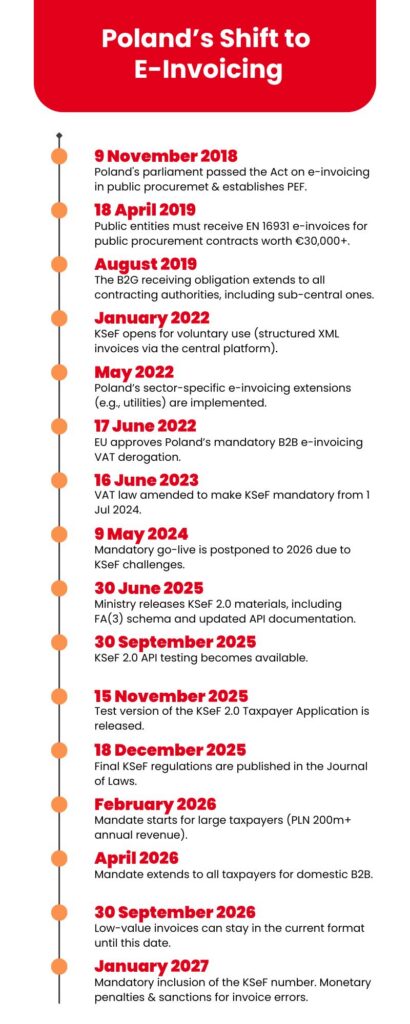
As of January 2026, Poland’s e-invoicing landscape is split. Since August 2019, all public sector entities have been required to receive and process structured e-invoices compliant with the European standard EN 16931 (XML/PEPPOL). To support this, Poland established a national e-invoicing platform, Platforma Elektronicznego Fakturowania (PEF), which operates within the OpenPeppol network and standardises secure, interoperable document exchange.
Here’s the split: so far, B2B transactions have not had to comply. Companies have still been free to exchange invoices outside the platform, using traditional formats such as PDFs, without routing them through a government system. But this is about to change.
In 2022, Poland received EU approval to change its VAT rules, which led to amendments to the Goods and Services Tax law in 2023. The goal was to make e-invoicing mandatory for all business transactions from July 2024. But the rollout did not go as planned. Although the National e-Invoicing System, KSeF, was introduced, the mandatory go-live was postponed to 2026 due to technical issues. Which brings us to today.
The upcoming change: mandatory e-invoicing for B2B transactions
In 2026, Poland plans to fully integrate KSeF with PEF, making it mandatory for all domestic B2B invoicing. The change will roll out in stages. Starting from February 2026, the mandate applies for all large taxpayers, generating over PLN 200m+ of annual revenue. Then, from April 2026, the mandate extends to almost all VAT registered Polish companies with limited exceptions, including transport and ticketing, financial and insurance services, and certain cross-border or self-billing arrangements.
As a grace period, there will be no monetary penalties for errors until the end of 2026. Additionally, low-value invoices (under PLN 450, or under PLN 10,000 per month) can remain in the current format until 30 September 2026. From 2027, all payments must include the KSeF number, or sanctions may apply.
PS: If your company is established outside Poland and you sell to Polish customers, you are generally not required to issue invoices through KSeF, as long as you do not have a fixed establishment in Poland.
What this means for your Polish business
- Your invoicing workflow becomes KSeF-centric, routing all your invoices through the platform for automatic validation. Accepted invoices = legally issued. Rejections ≠ legally not issued.
- Your systems must produce structured data. PDFs are not enough. Poland mandates the FA(3) XML format with required fields populated in a defined structure, typically generated from an ERP or billing system via API integration.
- However, if you are already using structured e-invoicing with your trade partners, for example over EDI, this will most likely remain as parallel flow. There is a lot of rich business data that KSeF does not support that may be in use in EDI documents (such as specific codes or delivery details).
- Receiving invoices changes too: Polish VAT-registered buyers must be technically ready to receive invoices via KSeF.
- You need contingency rules for outages. If real-time submission fails, invoices can be issued offline but must be uploaded to KSeF no later than the next business day. “Offline24” is part of the operating model.
- Compliance risk shifts over time. 2026 includes a monetary-penalty grace period, while administrative fines can apply from 1 January 2027 if mandatory KSeF invoicing is not respected.
How Telema can help
At Telema, we support businesses in navigating cross-border compliance, invoicing reforms and digitalisation. With Poland’s KSeF mandatory B2B e-invoicing rollout and the broader e-invoicing and reporting changes, our expertise can help you:
- Understand the standards, formats and permissible channels for e-invoicing in Poland.
- Assess your readiness and build a practical roadmap for migration to structured e-invoicing and reporting.
- Mitigate risk of disruption, invoice rejections, delayed payments or audit issues as the regime in Poland evolves.
In short, Telema will help you connect to Polish central e-invoicing system.
Conclusion
If you’re a Polish company, the time to act is now. Telema helps you to move toward KSeF on time, with structured e-invoicing support and end-to-end tracking. We’re here when you’re ready.