
UBL 2.5: e-invoicing is moving beyond the invoice
Sep 08, 2026
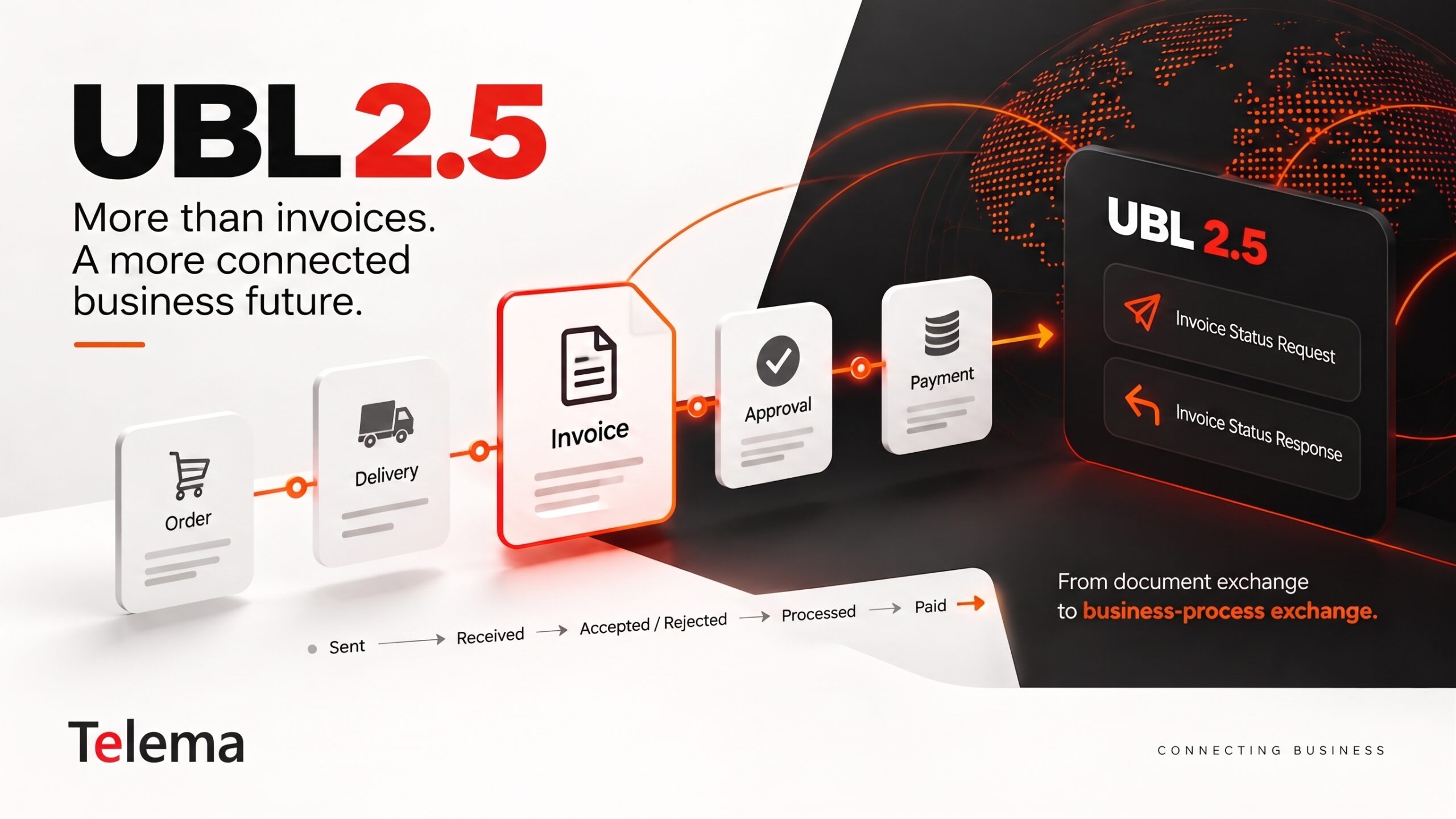
If you work with e-invoicing, you may have come across the abbreviation UBL. If not, now is a good time to get acquainted, because the standard behind much of Europe’s structured invoicing just had its biggest update in over a decade.
Universal Business Language (UBL) is an international open standard for structuring electronic business documents so different software systems can exchange and process them automatically. In addition, it covers: orders, delivery documents, credit notes and many other documents used in everyday trade.
UBL 2.1, published back in 2013, remains a core standard for European e-invoicing, including, for example, Peppol BIS Billing 3.0.
Approved on August 26, 2026, UBL 2.5 is the most significant release since version 2.1, according to its Technical Committee Chair Kenneth Bengtsson. It adds eight new document types to reflect modern digital business.
Thus, the e-invoice is becoming part of a broader digital dialouge between the buyer and sellere.
What has changed since UBL 2.1?
A lot has happened since 2013.
Structured e-invoicing has moved well beyond its early focus on B2G and public procurement. Global B2B mandates, Peppol expansion, and real-time tax reporting are now standard, as companies expect far more automation from their processes.
Beyond simple ERP invoice transfers, businesses now require structured data across the full cycle: orders, deliveries, acceptances, disputes, and payments.
Reflecting a broader trend, e-invoicing is integrating into a digital trade ecosystem connecting procurement, logistics, compliance, and payments.
What is new in UBL 2.5?
UBL 2.5 adds eight new business document types, taking the library from 93 to 101 documents:
- Delivery Note
- Invoice Status Request
- Invoice Status Response
- Work Report
- Procurement Status
- Procurement Status Request
- Waste Movement
- Waste Notification
Existing documents have also been expanded. Invoice and Credit Note structures now support additional purchase and delivery references, new parties such as the Beneficiary Party and Collected For Party, and more sophisticated payment and third-party collection scenarios.
Two further points signal where UBL is heading: the release adds support for ISO 14000 environmental standards, and lays the groundwork for JSON and other syntax bindings in future versions. Crucially, UBL 2.5 keeps backward compatibility with all existing UBL 2.x implementations — the standard evolves without forcing anyone to rebuild working integrations.
The new documents span very different areas, from procurement and logistics to environmental reporting. But for anyone following e-invoicing, Invoice Status Request and Invoice Status Response deserve particular attention.
Knowing what happened after the invoice arrived
Traditionally, electronic invoicing has focused on delivery. The seller sends an invoice; the invoice reaches the buyer; ideally both sides get confirmation it arrived.
Invoice sent → Invoice received
While simple, it leaves the important questions unanswered. Was the invoice accepted? Rejected because of incorrect data? Approved? Disputed? Paid?
UBL 2.5 introduces standard document structures for requesting and communicating invoice status, supporting a much richer exchange across the whole lifecycle:
Sent → Received → Accepted / Rejected → Processed → Paid
Though seemingly minor, this addition reflects a fundamental shift in what a digital invoice means.
Regulation is moving in the same direction
UBL isn’t evolving in isolation, as regulators are increasingly interested in what happens to an invoice after it is issued.
France’s new B2B e-invoicing system, whose first mandatory phase went live on 1 September 2026, includes an invoice-lifecycle concept, using status messages to communicate events during processing.
Spain goes further still. Under Royal Decree 238/2026, invoice recipients must report the status of each invoice — commercial acceptance or rejection, and full payment, including the relevant dates — within four calendar days. The goal is full invoicing lifecycle visibility and late-payment prevention.
These national systems use different technical approaches, so this does not mean UBL 2.5 has become the standard for lifecycle reporting in France or Spain. Regulations, business needs, and document standards are all moving toward structured, full-transaction communication.
From document exchange to business-process exchange
The biggest gains from electronic data exchange rarely come from swapping one document format for another.
Replacing PDF invoices with XML eliminates manual data entry and enables automation. But the real value lies in connecting the full chain: an electronic order generates a delivery note, matches and validates against the invoice, sends status back to the supplier, and closes the loop with payment.
It’s the difference between exchanging documents and digitizing inter-company processes.
For companies already using EDI, this is hardly new — orders, order responses, despatch advices, receiving advices, and invoices have formed connected document flows for years. What’s notable is that the e-invoicing world is moving in the same direction.
Does UBL 2.5 mean Peppol will change immediately?
No.
The publication of UBL 2.5 does not mean existing systems will suddenly migrate off UBL 2.1. Peppol BIS Billing 3.0 continues to use UBL 2.1. Any future adoption of UBL 2.5 will depend on updates to specifications such as Peppol BIS, EN 16931 and national frameworks, and is expected to be progressive rather than immediate. Some changes may still appear sooner through national extensions.
So businesses don’t need to start rebuilding integrations because UBL 2.5 has arrived, but ERP providers, e-invoicing operators, and automation designers should take note now.
The invoice is becoming part of a larger data flow
The most important message from UBL 2.5 is about where digital business is heading.
An invoice used to count as “successfully digital” once it could travel automatically from one system to another. Increasingly, companies need their systems to keep communicating beyond that point. The invoice is now a single event in a process which connects purchase, delivery, invoicing, approval, compliance and payment. UBL 2.5 solidifies this direction.
“For most of our customers, the hard part was never sending the invoice — it was knowing what happened to it afterwards. UBL 2.5 finally treats invoice status as structured data, not a phone call or a chase-up email. That’s the direction we’ve been building toward for years on the EDI side, and it’s good to see e-invoicing catch up.” — Hele Hammer, CEO, Telema
Need help navigating international e-invoicing requirements?
Telema helps companies exchange compliant e-invoices across different countries, networks and ERP systems — without having to manage every format and local requirement in-house. As standards like UBL 2.5 evolve, we track the changes so our customers don’t have to.
Request an e-invoicing consultation: