
2026 e-Invoicing mandates: key country updates and what businesses must prepare for
Dec 29, 2025

The year 2026 will be another step in the ongoing global shift toward mandatory e-invoicing. Governments are introducing new digital tax controls, replacing PDFs and paper-based workflows with structured electronic formats and real-time reporting. For companies operating internationally, understanding which markets are changing – and what those changes require – is essential for compliance and business continuity.
Below is an overview of the major countries with mandates taking effect in or around 2026, together with the expected changes and business implications.
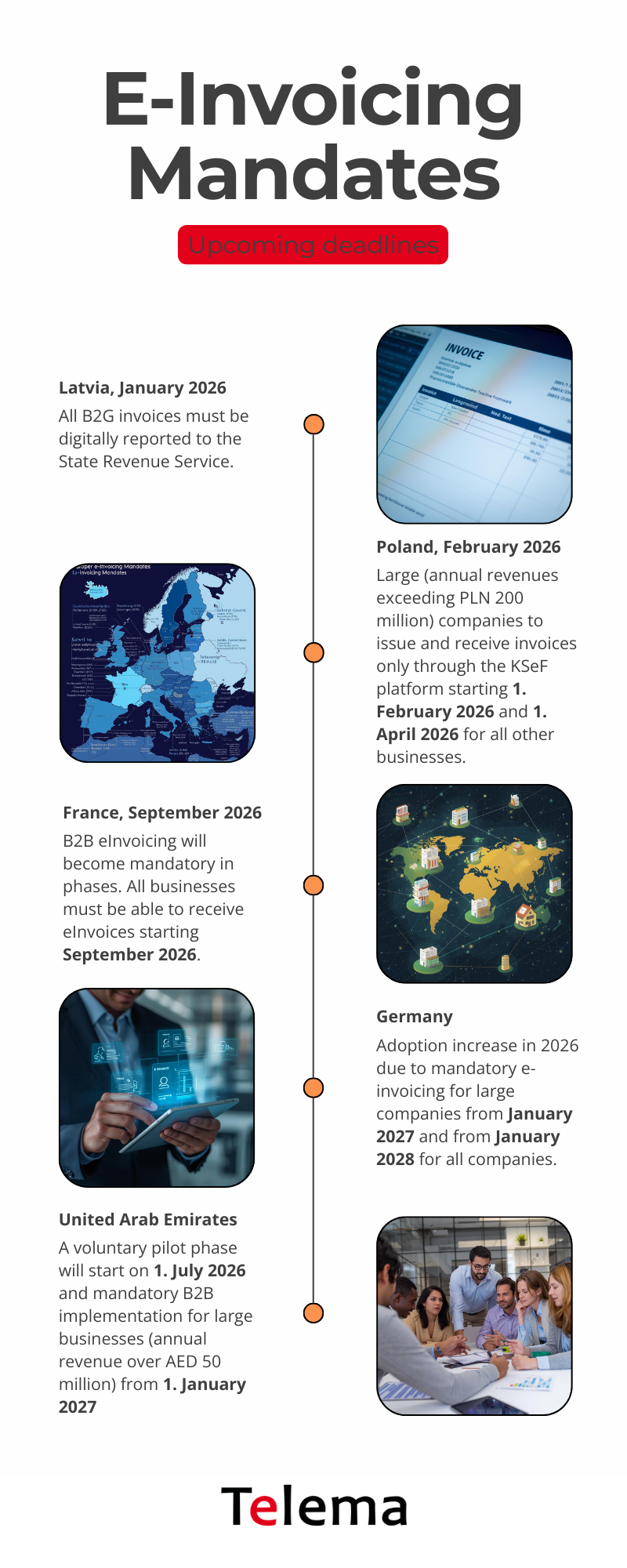
🇱🇻 Latvia: B2G E-Invoicing Reporting Requirement from 2026
Latvia is aligning with EU digitalization initiatives and expanding reporting obligations for public-sector transactions.
What’s expected in 2026:
- All B2G invoices must be digitally reported to the State Revenue Service (VID)
Implications for businesses: Suppliers to Latvian public entities must adopt structured e-invoicing and ensure compatibility with national reporting channels. Telema can help you with connection to eAdrese and the State Revenue Service. Read more.
🇵🇱 Poland: Nationwide KSeF Mandate Effective April 2026
Poland’s clearance system, KSeF, will require large (annual revenues exceeding PLN 200 million) companies to issue and receive invoices only through the platform starting 1 February 2026 and 1 April 2026 for all other businesses.
What’s expected in 2026:
- Real-time clearance of invoices
- Mandatory national FA(3) XML format
Implications for businesses: Real-time reporting demands high system reliability and automated error handling. Reach out to Telema when you need a connection to KSeF.
🇫🇷 France: Full B2B Mandate Expected September 2026
 France’s national platform, PPF (Portail Public de Facturation), will become central to B2B e-invoicing and e-reporting.
What’s expected in 2026:
- Mandatory B2B e-invoicing for all companies
- E-reporting for larger enterprises from September 2026
- Structured formats such as UBL, CII and Factur-X
Implications for businesses: Automation is essential as PDFs will no longer be acceptable for B2B invoicing.
🇦🇪 United Arab Emirates: Expanded E-Invoicing Requirements Expected
The UAE is progressing toward comprehensive e-invoicing as part of the Federal Tax Authority’s digital transformation agenda. A voluntary pilot phase will start on July 1, 2026 and mandatoryimplementation for large businesses (annual revenue over AED 50 million) from January 1, 2027
What’s expected in 2026:
- Adoption of e-invoicing through Accredited Service Providers
- Structured, machine-readable format (PINT AE XML)
- Real time reporting to the FTA
Implications for businesses: Companies must prepare for a structured Peppol based 5-corner e-invoicing process. Reach out to Telema if you are interested in eInvoice solutions in UAE.
🇩🇪 Germany: Obligation to Issue Structured E-Invoices Expected
Germany has been requiring companies to receive structured e-invoices from January 2025. At the same time, it is important to prepare for the issuing of e-invoices as it will become mandatory in 2027 for larger enterprises and 2028 for all German businesses.
What’s expected in 2026:
- Preparation for issuing invoices in XRechnung or EN-compliant formats
- Phase-out of non-structured PDF invoices
- Harmonised validation rules across federal states
Implications for businesses: Companies must ensure their ERP systems can generate and exchange compliant invoices.
What This Means for Businesses in 2026
With several major markets transitioning simultaneously:
- Non-structured PDF invoices will no longer meet legal requirements in many jurisdictions
- When you do over-the-border business, you will most likely need to support multiple formats (UBL, PINT AE, XRechnung, national XML schemas). Make sure your e-invoicing operator can support you properly in these cases.
- Clearance systems like Poland’s KSeF require real-time, fault-tolerant integrations – again, careful consideration is needed when selecting your e-invoicing and e-reporting partners.
- Reporting obligations (e.g., in Latvia) demand standardized data structures and automated workflows. Let your e-invoice operator help you with ensuring those or make sure your ERP can do this for you.
Companies that prepare ahead of time will reduce operational risk, avoid compliance penalties, and benefit from the efficiency gains of automated invoicing.
Telema is specialized in the digitalization of business processes. Reach out today if you need help with e-invoicing, AP automation or EDI.